Excavator Main Hydraulic Pump: OEM vs Aftermarket Guide
A failed main hydraulic pump is the most expensive single component failure on a working excavator, and the supply decision that follows it either protects the machine or repeats the failure. The pump is a precision assembly whose internal parts are machined and inspected as a matched set, and it sits in the most contamination-sensitive circuit on the machine. This guide compares the three realistic supply routes - genuine OEM-new, quality aftermarket-new and rebuilt exchange units - on price, lead time and risk.
Why the Pump Decision Is Different
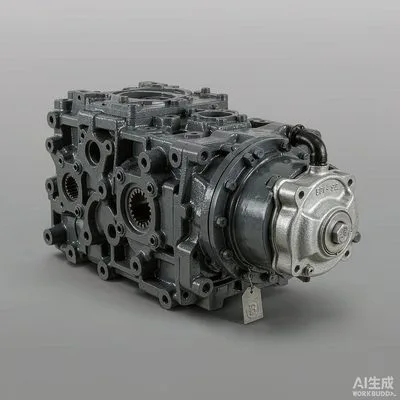
Two properties set the main pump apart from seals, filters and even final drives. First, the rotating group - cylinder block, pistons, valve plate and swash plate - is manufactured to micron-level clearances and inspected as a matched set; a unit assembled from mismatched internals loses efficiency within weeks or seizes within hundreds of hours. Second, the pump runs at the highest pressure in the circuit, which makes it the first victim of contaminated oil - a low-price unit fitted to a machine with dirty oil usually becomes a second, more expensive failure.
Identify the Pump Before You Compare Prices
Every serious quote starts with identification, not price. Record the machine model and serial number, then photograph the pump nameplate: most excavator main pumps carry the pump manufacturer's own code in addition to the machine brand. Kawasaki units such as the Kawasaki K5V80DTP main pump fitted to the Hyundai R150-9 supply a wide range of mid-size machines; Rexroth AP2D36 units appear on the Rexroth AP2D36 pump for the Doosan DH80-7 and on compact machines such as the Rexroth Uchida AP2D36 pump for the Takeuchi 80 class; and large CAT machines use the 3228733 main pump assembly for the CAT 330D and 336D. The nameplate photo removes almost all fitment risk before money changes hands.
The Three Routes at a Glance
|
Route |
Typical price index |
Lead time |
Where it fits |
|
OEM-new (genuine) |
100 (baseline) |
2-6 weeks ex-factory; faster if stocked |
Warranty machines, high-value fleet units, tight-tolerance variable-displacement pumps |
|
Aftermarket-new (quality) |
40-60% of OEM |
Often ex-stock |
Machines past warranty where the owner caps the repair cost |
|
Rebuilt / exchange |
25-40% of OEM |
Ex-stock against core return |
Budget rebuilds on older machines with clean oil history |
Price indexes are indicative ranges in the aftermarket channel with OEM-new as the baseline, not quoted prices. The ranking never moves: genuine parts price highest, documented rebuilt units lowest, and the gap between them is where the decision lives.
When OEM-New Is the Right Call
Genuine OEM-new pumps are the default choice in three situations. The first is any machine still under warranty or a certified rebuild programme, where a non-OEM component can void coverage. The second is high-value, high-utilization machines - a large Volvo unit such as the Volvo EC460 main pump or a Hitachi Hitachi ZX850-3 main pump - where one day of pump downtime costs more than the price premium of the genuine part. The third is tight-tolerance variable-displacement designs, where internal clearances leave no room for a generic substitute. In these cases the OEM premium is insurance, not luxury.
Where Quality Aftermarket-New Wins
For machines past their economic warranty, aftermarket-new pumps from a supplier with verifiable quality control are the rational buy. Modern aftermarket manufacturers machine cylinder blocks and valve plates on the same class of equipment as the OEM and often publish test-bench reports with delivery; the 40 to 60 percent saving against OEM usually covers the fitting cost several times over. The category spans the full size range, from compact machines - the Komatsu PC30MR-1 main pump, the Kubota U30-5 main pump, the JCB 130 and 160 main pump and the main pump for the CAT E305 - up to mid-size units such as the Hyundai R210-7 and R215-7 main pump. Buy from a supplier who states the pump manufacturer, the source of the internal parts and the test pressure, and who warrants the unit in writing. Our hydraulic main pump category lists the assemblies we stock across these machine classes.
Rebuilt and Exchange Units: What to Ask
Rebuilt exchange units are the budget route, and they are legitimate when the questions are asked before the core ships. A credible rebuilder documents core condition on arrival, replaces the rotating group and valve plate as a matter of course, pressure-tests the unit on a bench, and states the warranty in writing. What to ask: which internal parts are new, what test pressure and flow were recorded, and how long the warranty covers parts and labour. Rebuilt units fit older fleets - the Volvo EC210B main pump, the Kobelco SK200-8 and SK210-8 main pump or the Sumitomo SH300A1 and SH300A2 main pump - where machine value does not justify a new pump. What never fits any machine is an undocumented unit with no test data.
Five-Step Buying Checklist
· Match the pump nameplate code to the quote, not just the machine model.
· Ask who manufactured the unit and whether test-bench data comes with it.
· Confirm warranty terms in writing: duration, coverage and core-charge rules.
· Check hydraulic oil and tank condition before fitting - a new pump in dirty oil fails fast.
· Flush the lines, change oil and filters, then verify relief pressures after start-up.
Three Costly Mistakes
The first mistake is buying on machine model alone: several pump variants exist across serial ranges, and the nameplate code is the only safe identifier. The second is fitting a new or rebuilt pump into a system with contaminated oil - the pump becomes the filter and fails within weeks. The third is skipping post-installation checks: relief-pressure verification at operating temperature catches assembly errors under warranty.
Q: Is an aftermarket main pump safe for a machine still under warranty?
A: Usually not. Most OEM warranty programmes require genuine or approved components in the hydraulic circuit, and a third-party pump can void coverage. On out-of-warranty machines the saving becomes real.
Q: How long does a rebuilt main pump last compared with a new one?
A: A documented rebuild with a new rotating group typically delivers 60 to 80 percent of new-unit life when the oil is clean, at roughly half the OEM-new price. Oil condition and rebuilder documentation decide the outcome, not the label on the box.
Q: Can you supply a main pump for a compact or mini excavator?
A: Yes - compact and mini classes are fully covered, including Komatsu PC30-series, Kubota U30-5, JCB 130/160 and the Rexroth AP2D36 units for Takeuchi 80 and Case 75 machines, in OEM-new, aftermarket-new and rebuilt options. Send the model, serial and nameplate photo and we will confirm the assembly.
The right pump decision is rarely the cheapest line on the quote; it is the route that matches the machine's value, warranty status and oil condition. Identify the unit by its nameplate code and ask for the test data before you pay. Send your model code, serial number and a photo of the pump nameplate to our team on WhatsApp at +86 18758866446, or request a quote through the contact page, and we will confirm the correct assembly and price within four working hours.