Excavator Sensor Buying Guide: OEM vs Aftermarket vs Used
A failed sensor rarely stops an excavator outright - it blinds the machine. The control system derates power, a gauge reads a lie, or an operator works blind. The sensor itself is usually cheap; the expensive part is buying the wrong one twice. This guide compares the sourcing routes for excavator sensors and tells you which route each sensor family actually deserves.
Why Sensors Break the Normal Parts Rules
Mechanical parts forgive approximation; sensors do not. Three factors decide every sensor purchase. Exact match comes first: thread size, hex size, connector shape and pin count must all agree, because the harness does not adapt. Signal match comes second: the controller expects a specific output curve or resistance range, and a unit that reads ten percent off triggers the same fault codes as a dead one. Consequence comes third: a pressure sensor that under-reads lets a relief valve work overtime, while one that over-reads derates a healthy machine.
Four Sourcing Routes Compared
Sensors reach the aftermarket through four routes. The right route depends on the family, not the brand.
|
Route |
Price index |
Risk |
Best for |
|
OEM new |
100 |
Lowest |
Common-rail, NOx and ECU-adjacent sensors |
|
Aftermarket new |
30-60 |
Low if spec-matched |
Standard pressure, temperature and speed sensors |
|
Used / pulled |
10-20 |
High: unknown history |
Simple on/off switches, bench-tested only |
|
Rebuilt / recalibrated |
40-70 |
Medium: depends on bench |
Monitors and instrument clusters |
Price indices are indicative ranges, not quotations.
Where OEM Is the Only Safe Choice
Two zones tolerate no experiment. Common-rail fuel pressure sensors sit in fuel streams above 1,600 bar, and a drifted reading corrupts injection timing across the whole engine. Aftertreatment sensors - NOx probes and their temperature neighbours - survive heat cycles that destroy cheap elements and feed emissions-critical decisions. In both zones, buy OEM or a unit with a documented calibration certificate. Cummins N14 and M11 installations rely on units like the Dodge oil pressure sensor switch transducer 4921487 and 3080406, while CAT's aftertreatment line depends on sensors such as the Caterpillar NOx sensor 539-0118 for C13, C15 and C18 engines. These are specification parts, not wear items.
Where Aftermarket New Wins
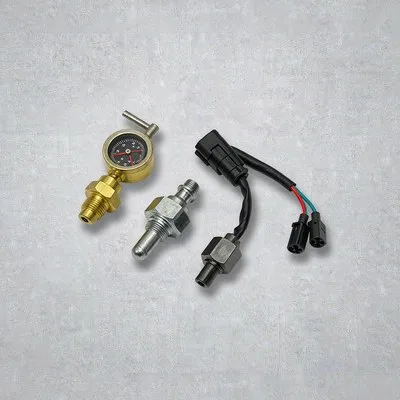
Standard sensing hardware is a different story. Hydraulic pressure switches, coolant and oil temperature sensors, and magnetic speed sensors are mature designs, and quality aftermarket units match the OEM output curve at a fraction of the price. Caterpillar E-series machines use pressure switches like the CAT pressure switch and sensor 126-2938 across the E320A, E312B, E320C and E330, speed sensors such as the CAT speed sensor 196-7973 and 125-2966 and the CAT E320D and E330D speed sensor, and coolant sensors like the CAT water temperature sensor 238-0112 for the 311D through 315D. Loader installations draw on the CAT pressure sensor switch 216-8684 and the CAT speed sensor switch 319-6491, while AP-series carriers use the CAT oil and fuel pressure sensor 1611705. Hyundai wheeled machines draw on the Hyundai R500LC7 pressure sensor 31Q4-40800 and the Hyundai R55W-9 pressure sensor 31Q4-40820, and the excavator coolant temperature sensor 94650-72400 for D6AB engines covers a broad installation base. The wider pressure sensor catalogue lists the common ranges. Here, price competition works in your favour.
The Used-Sensor Trap: Four Hard Rules
Used sensors look attractive because they are cheap and identical. Four rules keep them safe. Never buy a used precision analog sensor without a bench test against a known reference. Never install a used NOx or common-rail sensor, because element history is invisible. Check the connector for corrosion and pin stretch before the unit ships. And record the calibration range printed on the old sensor before removal, so the replacement can be compared line by line. A used on/off pressure switch that passes a bench test is a legitimate saving; a used rail sensor is a gamble with your engine.
Adjacent Wear Items: Throttle Motors and Control Panels
One group of electrical parts sits between sensing and mechanics: throttle motors, accelerator knob switches and control panels. They convert operator input into signals and they wear physically, which makes aftermarket new a safe default. Komatsu PC-series machines use throttle motors like the Komatsu throttle motor 7834-41-2000, Hyundai machines the Hyundai R225-9 throttle motor 21EN-32340 and the Hyundai R60-9 throttle motor 21M9-51100, Kobelco SK200-6 machines the Kobelco SK200-6 throttle motor assembly YN20S00002F3, and CAT E-series cabs the CAT throttle stepping motor CA2475210. Interface hardware such as the Doosan and Hyundai fuel throttle knob switch 300661-00004 and the Hitachi and John Deere throttle control panel 4454518 follows the same rule. The wider throttle motor catalogue and electrical parts catalogue cover the rest of the range.
Verify Before You Order: Six-Point Checklist
· Machine model and serial number, not just the family - the serial decides the sensor variant.
· The part number stamped on the old sensor, photographed before removal.
· Connector pin count, keying and wire colours matched to the harness.
· Thread size and hex size measured with calipers, not eyeballed.
· Pressure or temperature range printed on the old sensor's label.
· For analog sensors, the resistance or voltage specification from the service manual.
Common Buying Mistakes
Three mistakes dominate: buying by photo match, when identical bodies hide different ranges and connector pinouts; mixing sensor technologies on one circuit, which leaves the controller reading a fixed value; and letting price decide in the rail and NOx zones, where a failed bargain costs an injector or an aftertreatment overhaul.
Q: Can I use aftermarket sensors on a Tier 4 machine?
A: For coolant, hydraulic oil and standard pressure circuits, yes - a spec-matched aftermarket unit performs identically. For NOx, aftertreatment temperature and common-rail sensors, insist on OEM or documented-calibration units; emissions-critical circuits leave no margin for drift.
Q: How do I identify a sensor when the part number is gone?
A: Measure thread and hex size, count the connector pins and note the wire colours, then match against the machine's parts catalogue by serial number. Our team can run that lookup from a photo and your serial plate.
Q: Is a used sensor ever acceptable?
A: Only for simple on/off pressure switches that pass a bench test, and only when the connector is clean. Precision analog sensors, NOx sensors and rail sensors should always be new.
Sensors are the cheapest insurance on the machine and the most expensive place to guess. Match the family to the sourcing route, verify the six points, and keep the old part until the new one is proven. Send your machine model, serial number and a photo of the old sensor to our team on WhatsApp at +86 18758866446, or request a quote through the contact page.