Excavator Cooling Faults: Diagnose Overheating and Fix It
An excavator that overheats does not fail politely - it derates, boils over, or cooks a hydraulic pump mid-shift. Most overheating traces back to a small set of components: radiator core, thermostat, water pump, fan, or an oil cooler. This guide walks the diagnosis order that separates a twenty-dollar thermostat from a five-figure power train event.
Two Circuits Share One Cooling Package
Excavator cooling is not one system. The engine coolant circuit runs through the radiator, water pump, thermostat and fan. The hydraulic circuit pushes tank oil through separate oil cooler cores; oil passing a relief valve every cycle heats independently. Turbocharged machines add a third circuit: charge air crosses an intercooler or aftercooler before the intake. A machine can run hot on one circuit while the others read normal, so decide which circuit is overheating first.
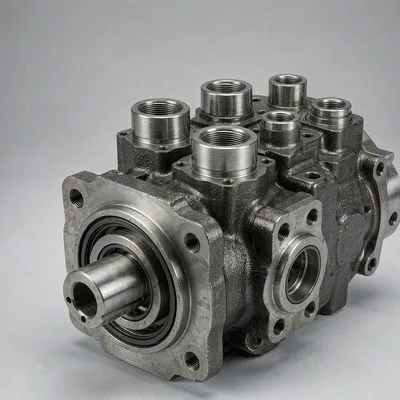
The coolant side starts with the water pump catalogue and the thermostat range; the hydraulic side with our oil cooler core catalogue; fan and belt problems begin at the fan motor range section.
Symptom, Cause, First Check
|
Symptom |
Likely cause |
First check |
|
Temperature climbs within minutes of load |
Thermostat stuck closed or low coolant |
Feel the upper versus lower radiator hose by hand |
|
Coolant boiling out of the overflow |
Pressure cap failed or combustion gas entering coolant |
Test the cap rating, then check for exhaust gas in the header tank |
|
Slow warm-up, cab heater stays lukewarm |
Thermostat stuck open |
Watch the gauge through the first ten minutes of running |
|
Hydraulic oil above 95 C, functions turn sluggish |
Oil cooler core restricted or bypassing |
Compare oil temperature at the relief valve and after the cooler |
|
Coolant level drops with no external leak |
Core internal failure or head gasket breach |
Check the engine oil for coolant and the coolant for oil |
|
Weep trail at the pump face, whining note |
Water pump seal or bearing failing |
Inspect the weep hole and verify belt tension |
|
Engine hot but radiator stays cold |
Circulation failure: airlock, blockage or dead pump |
Squeeze the upper hose at idle, then bleed the system |
Six-Step Overheat Diagnosis Order
· Confirm which circuit is hot: coolant, hydraulic oil, or charge-air temperature. Record all three first.
· Check coolant level and pressure cap cold - a cap that holds no pressure drops the boiling point.
· Verify thermostat operation by hose temperature split: a closed unit leaves the upper hose scorching and the lower cool.
· Confirm fan drive: belt condition and tension, coupler engagement on thermo-fan models, motor condition.
· Inspect the core for clogged fins and internal scale; a clean-looking core can still be blocked inside.
· Only then suspect the water pump: weep-hole traces, bearing noise, impeller cavitation - after the cheaper checks pass.
Diagnosing the Hydraulic Oil Cooling Side
Hydraulic overheating reads differently: the engine gauge stays normal while oil temperature climbs and functions lose speed, usually from a restricted oil cooler core. C9-powered machines in the 330C, 336D and 336E class use units like the CAT oil cooler core 2939367 fitted to the C9-powered 330C, 330D, 336D and 336E excavators, with the Caterpillar hydraulic oil cooler 4W0418 covering wide Caterpillar applications. On the Volvo side the Volvo oil cooler 468612 for the EC420 excavator and the Volvo oil cooler 4777033 for the EC420 excavator both serve the EC420, and JCB machines draw on the JCB hydraulic oil cooler 32004660 for the JS200 excavator for the JS200. Cummins NH855 and NTA855 installations rely on cores such as the Cummins oil cooler core 3045483, 3412285 and 3018692 and the complete Caterpillar oil cooler assembly 4W7190, 4W7188 and 6N9215 for the D6C, D6D and D7F assembly.
The dangerous failure mode is cross-contamination: when a core cracks internally, coolant and oil mix - engine oil turns milky, or the header tank shows an oil film. Either sign means the core has failed, and running on risks pump and engine together. The Volvo oil cooler VOE4804681 and comparable Volvo cores are stocked as complete replacements for exactly this reason.
Charge-Air Cooling on Turbo Machines
Turbocharged machines add a third overheating story. A blocked aftercooler or intercooler raises intake temperature, and the engine answers with power loss and black smoke before a gauge reads alarming. Large CAT installations such as the 3516 use cores like the CAT 3516 aftercooler core 1134655, while Cummins 6CT and 8.3L engines use units such as the Cummins intercooler 3924731 for the 6CT and 8.3L engines. Measure manifold intake temperature against specification and clean the core from the air side.
Repair or Replace: Component by Component
Water pumps are replaced, not rebuilt: an unknown impeller is a second failure waiting. The Kubota KVC310D water pump for the D722 engine is a typical direct replacement for compact Kubota machines. Thermostats are replaced with the correct temperature rating, never tested back into service; the thermostat range lists the common ratings. Radiator cores like the CAT radiator 377-5263 for the 416F, 420F, 428F, 430F and 432F backhoe loaders can be recored when the tanks are sound; repeated failures justify a new assembly. Coolant loss with no visible leak points at the Volvo expansion water tank 20936055 or a cracked header tank. Transmission cooling is separate: the CAT transmission oil cooler 1873523 for the 966G, D6T and D6R, the JCB transmission oil cooler 30-921200, 30-919900 and 30-925441, and the JCB oil cooler 32004138 and 32004115 for the 3CX, 214, 215, 1400B and 1700B backhoes sit in their own circuits and fail without touching engine temperature.
Common Diagnostic Mistakes
The first mistake is parts-cannon diagnosis: thermostat, then pump, then radiator, while the real fault is a weak cap or an airlock. The second is ignoring oil temperature because the engine gauge reads normal. The third is pressure-washing a clogged core from close range, which folds fins flat and cuts airflow. The fourth is mixing coolant chemistry, which forms gel that blocks the core from inside. The fifth is skipping the combustion-gas test after a boil-over.
Q: My excavator only overheats under load - where do I start?
A: Start with the thermostat and the cap. Load raises heat input, and a partially opening thermostat or weak cap that passes at idle will fail when demand peaks. Check hose temperature split and cap rating first.
Q: Can I keep running with a small coolant leak?
A: Only long enough to finish the lift, and only with plain water. A leaking system pulls in air as it cools, creating airlocks and hot spots that warp a head. Find the source - hose, clamp, weep hole or core - before the next shift.
Q: How do I tell a failed oil cooler from a bad thermostat?
A: Measure both temperatures. A stuck thermostat spikes coolant temperature within minutes while oil lags. A failed oil cooler leaves coolant acceptable but pushes oil past 95 C with sluggish functions. Milky oil or an oil film in the header tank confirms a cracked core.
Overheating is a symptom, not a diagnosis - work the circuits in order and replace the failed component with the correct part. Send your machine model, serial number and readings to our team on WhatsApp at +86 18758866446, or request a quote through the contact page, and we will confirm the right part for your machine.