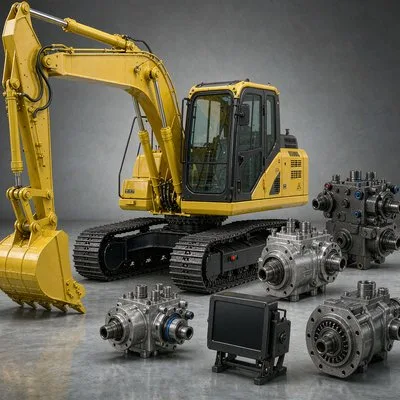
Excavator Engine Hard Start & Power Loss: Diagnose & Fix
Every fleet manager knows the call: a machine that ran fine yesterday cranks, fires and dies, or refuses to start at all. Most such failures trace back to a handful of causes that can be isolated in under an hour with basic tools. This guide walks through a field-tested diagnosis flow for hard starting and power loss, linking each likely cause to verified parts in our catalogue.
Start With Fuel, Air and Compression
A diesel engine needs clean fuel at high pressure, unrestricted air, and enough compression to ignite the charge. When a machine cranks but will not fire, work through those three in order before replacing anything. Check the water separator and primary filter first - contaminated fuel causes more no-starts than any failed component. Then verify the fuel shut-off solenoid receives power. Compression loss shows up as cranking that sounds unusually fast and even, with no hint of firing; that points to rings, liners or valves rather than fuel.
Cranks But Will Not Start: Fuel System First
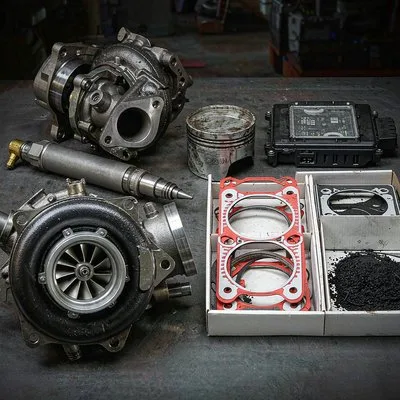
If the starter turns the engine briskly but nothing happens, suspect the high-pressure side. A worn C7 fuel injector 387-9427 / 10R-7225 sprays a weak, poorly atomised cone that will not ignite in cold metal, and one dead cylinder is often enough to stop the whole engine. On machines that ran out of fuel or sat for long periods, air locked in the lines produces identical symptoms, so bleed the system before ordering parts. Low transfer pressure is the other frequent culprit: a tired Volvo EC210 feed pump 20518337 starves the injection pump, and the engine fires briefly then dies. Fit a gauge at the filter head and compare against the specification before you buy.
Read the Smoke Before You Open the Hood
Exhaust colour narrows the diagnosis faster than any test gauge.
|
Smoke colour |
What it means |
Where to look |
|
Black, under load |
Too much fuel, too little air |
Restricted intake, turbo boost leak, injector over-fuelling |
|
White, unburnt fuel |
Fuel igniting late or not at all |
Low compression, weak injectors, retarded timing |
|
Blue, continuous |
Oil burning in the cylinders |
Worn rings or liners, turbo seal leakage |
Black smoke with normal start behaviour stays an airflow or injector-quantity issue. Continuous white smoke that never clears on a warm day is the classic low-compression signature: the engine turns, fuel enters, but heat escapes past worn rings or a leaking head gasket. Blue smoke means oil is burning, and the repair conversation shifts from fuel system to bottom-end components.
Starts Fine, Then Loses Power Under Load
Power fade under load is a different fault family from no-start. Begin with the simple causes - a clogged air filter or a collapsed intake hose mimics serious engine wear. Next, watch the exhaust under load: black smoke that clears as the engine revs suggests fuel starvation, while steady black points to over-fuelling or boost loss. If blow-by gas pulses strongly from the breather, ring wear is real. A fresh C7 piston ring set 1979353 restores sealing on CAT C7 machines before wear reaches the liner surface, and when honing is already required the matching Volvo D6D liner kit covers Volvo D6D engines in one purchase.
When the Engine Is Not the Problem: ECM and Wiring
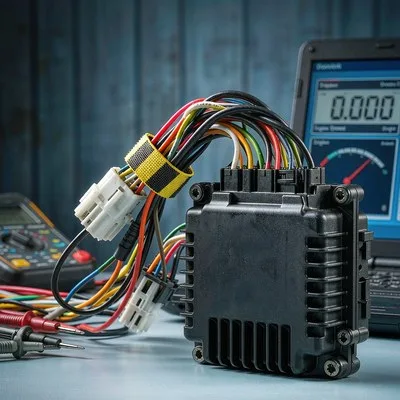
Modern engines refuse to start for electrical reasons that look mechanical from the cab. A failed engine ECM 331-7539 on CAT C4.4 to C6.6 platforms kills injection drive completely, and the engine cranks exactly as it would with no fuel. Before condemning the controller, confirm cranking voltage stays above nine volts, check both earth straps, and inspect harness connectors for corrosion. Only then swap the controller - units like the 331-7539 must match both the engine family and the machine wiring, so quote the engine serial number when you order.
Repair, Overhaul or Replace
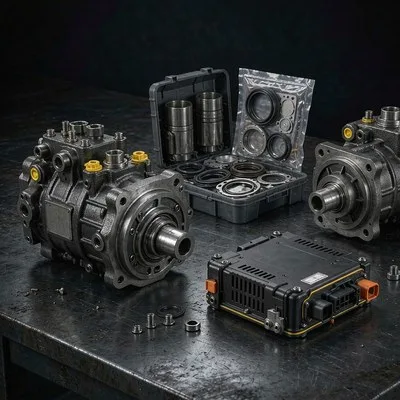
The decision comes down to how many systems are worn. A single weak cylinder with a polished liner justifies a ring and liner kit. Multiple low cylinders, blue smoke and high blow-by together justify a full overhaul: the C9.3B overhaul repair kit bundles pistons, liners, rings, main bearings and the gasket set for CAT C9.3B engines. On compact machines a cracked head is usually cheaper to replace than machine: the Kubota D1503 cylinder head 1A013-03043 suits Kubota D1503 engines, and the C18 cylinder head gasket 2245122 handles CAT C18 head sealing during top-end work. Cracked blocks and scored cranks end the repair argument: the Cummins 6BT cylinder block 3928797 suits Cummins 6BT builds, the JCB 444 crankshaft 320/09256 fits JCB 444 engines, and for high-hour machines the Yanmar 4TNV98 complete engine assembly returns a Yanmar 4TNV98 to service faster than any rebuild. Browse the full engine parts range for platforms not listed here.
|
Symptom |
Most likely cause |
Verified part on this site |
|
Cranks, no start |
Injectors / feed pump / air in lines |
C7 injector 387-9427; EC210 feed pump 20518337 |
|
White smoke, no fire |
Low compression or head gasket |
D6D liner kit; C18 head gasket 2245122 |
|
Blue smoke, high blow-by |
Ring and liner wear |
C7 piston ring 1979353 |
|
No crank fault codes |
ECM or wiring |
Engine ECM 331-7539 |
Five-Step Field Diagnosis Checklist
· Drain the water separator and inspect fuel for water or algae before anything else.
· Measure cranking voltage and speed; weak electrics imitate every engine fault.
· Bleed the fuel system end to end after any filter change or run-dry event.
· Test compression or watch the breather for blow-by before ordering internals.
· Record the engine serial number and old part casting numbers before requesting a quote.
Three Mistakes That Turn a Small Repair Into a Rebuild
First, replacing injectors on a machine that never had fuel pressure - the new nozzles fail within days and the bill doubles. Second, running a blue-smoking engine until rings scuff the liner, converting a ring job into a full re-sleeve. Third, ordering overhaul parts by machine model instead of the engine serial number, because the same excavator model left the factory with different engine variants. A two-line email prevents all three.
Frequently Asked Questions
Q: Why does my excavator start and then die after a few seconds?
A: Almost always fuel starvation: air in the lines, a clogged separator or a weak feed pump. Bleed the system and measure transfer pressure before replacing injectors.
Q: Can I order overhaul parts using only the machine model?
A: Not safely. The same model can carry different engine variants. Quote the engine serial number and the casting numbers on the old parts, and we confirm the exact kit.
Q: How do I know if it is the ECM and not the engine?
A: Check for fault codes and cranking voltage first. A weak battery dropping below nine volts while cranking mimics controller failure; replace the ECM only after both checks.
Get the Engine Running, With the Right Parts First Time
Diagnosis is a sequence, not a guess: fuel, air, compression, electrics - in that order. Send us the engine serial number and a photo of the failed part, and we will match it against live stock. Message our WhatsApp at +86 18758866446 or request a quote through the contact page for price and lead time within four working hours.