Dealer vs Overseas Supplier: Excavator Parts Sourcing Guide
When a Cat C7 injector fails or a Kubota D1503 cylinder head cracks, you face a sourcing decision before the technical one: do you call the authorized dealer, or order from an overseas aftermarket supplier? Both channels can get your machine running, but they differ sharply on price, lead time, warranty, and risk. This guide compares the two models with real part numbers so you can build a sourcing strategy that protects uptime and budget.
Why Your Sourcing Channel Matters
Excavator downtime is expensive. A machine sitting in the yard earns nothing while the repair bill grows, so the sourcing channel you choose directly affects how fast and how cheaply you recover. Authorized dealers offer genuine parts and factory backing but at a premium and often with long backorders. Overseas aftermarket suppliers, including XC Machinery, offer vetted new aftermarket and quality remanufactured parts at a fraction of OEM cost, with the trade-off that you must vet the supplier yourself. Understanding both models lets you route each repair to the right source.
Authorized Dealers: Pros and Cons
Advantages
Dealers guarantee genuine fit and carry the full factory warranty, which matters when the machine is under OEM coverage or the part is emission-critical. They also hold the service history and can confirm fitment by serial number. For a precision component like a Cat C4.4 to C6.6 ECM 331-7539, dealer backing removes calibration uncertainty.
Drawbacks
The cost is the obvious downside: a genuine common-rail injector for a Cat C7 can run two to three times the price of a quality aftermarket 387-9427 unit. Lead times of four to eight weeks are common for older engines, and dealer stock for discontinued models simply disappears. For a fleet running many wear items, dealer pricing rapidly becomes unsustainable.
Overseas Aftermarket Suppliers: Pros and Cons
Advantages
A reputable overseas supplier delivers new aftermarket parts that match OEM dimensions and performance at 30 to 50 percent of list price, with six to twelve month warranties on serious listings. For bolt-on wear parts such as a JCB fuel filter head 320/09256 or a Cummins 6BT stop solenoid 3928797, this is pure savings with statistically low failure risk. Inventory depth for older machines is another advantage: a supplier like XC Machinery still stocks a Kubota D1503 cylinder head 1A013-03043 that the OEM may have discontinued.
Drawbacks
The burden of vetting shifts to you. Quality varies by manufacturer, shipping adds lead time measured in days rather than hours, and a bad supplier can ship an unbranded part with no traceable number. Calibrated components need test documentation, and returns across borders are slower than a local counter swap.
Head-to-Head Comparison
On cost, overseas aftermarket wins for wear and maintenance items; dealers win only where warranty mandates genuine. On lead time, dealers are faster locally but slower on backorders, while overseas suppliers are predictable at one to three weeks. On risk, dealers are lower for emission-critical parts, overseas suppliers are lower for mature wear items. The right answer is rarely all-or-nothing.
How to De-Risk Overseas Sourcing
Verify the Part Number
Always confirm the OEM cross-reference number against your machine model and serial number before ordering. Quality aftermarket parts publish the reference number, for example 387-9427 or 1A013-03043, so fitment is checkable rather than assumed.
Ask for Test and Warranty Docs
For calibrated parts like injectors or ECMs, request the test bench report and the written warranty. A supplier who cannot show flow rates for a 10R-7225 reman injector or warranty terms for an ECM is a risk you should price in.
Start with Wear Items
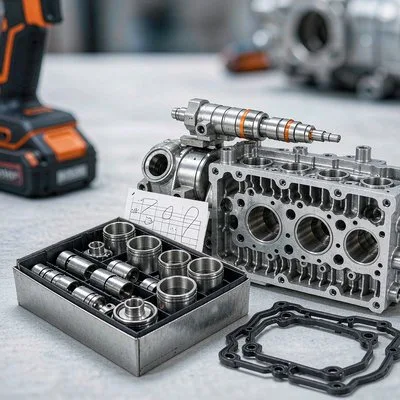
If you are new to a supplier, begin with low-stakes, easily swapped parts such as filters, gaskets, and an overhaul kit like the Cat C9.3B overhaul kit. Prove reliability on a 3928797 solenoid before committing to a high-value cylinder head.
A Practical Hybrid Strategy
Most professional fleets run a hybrid: genuine OEM for emission-critical and warranty-covered parts, vetted aftermarket for the long tail of wear items, and quality reman for calibrated components from a documented rebuilder. This balances cost, uptime, and risk without overpaying on every bolt. Keep a standing cross-reference list of your most common failures so ordering takes minutes, not hours.
Frequently Asked Questions
Do aftermarket parts void my machine warranty?
In most markets, fitting an aftermarket part does not void the whole machine warranty, but the OEM can deny a claim if that part caused the failure. For emission-related components, check local regulations before substituting.
How do I confirm an overseas supplier is legitimate?
Look for a real business address, published material and heat-treatment specs, traceable part numbers on every listing, and responsive technical support. A supplier that answers fitment questions by part number, not just by model, is operating at a professional level.
Can I mix aftermarket and OEM on the same repair?
Yes. It is common to use an aftermarket gasket kit with a genuine injector, or a reman injector with new aftermarket fuel lines. Match each part to its risk profile rather than buying one brand for the whole job.
Conclusion
Your sourcing channel should follow the risk, not a habit. Use dealers where warranty and emissions demand it, and use vetted overseas suppliers for the wear items and discontinued parts that make up most of your spend. XC Machinery stocks real, traceable aftermarket and remanufactured parts for Cat, Komatsu, Cummins, Kubota, JCB, and Volvo engines, every listing tied to a genuine part number. Send us your part number and machine model on WhatsApp or request a quote today, and we will confirm fitment and lead time within 24 hours.